
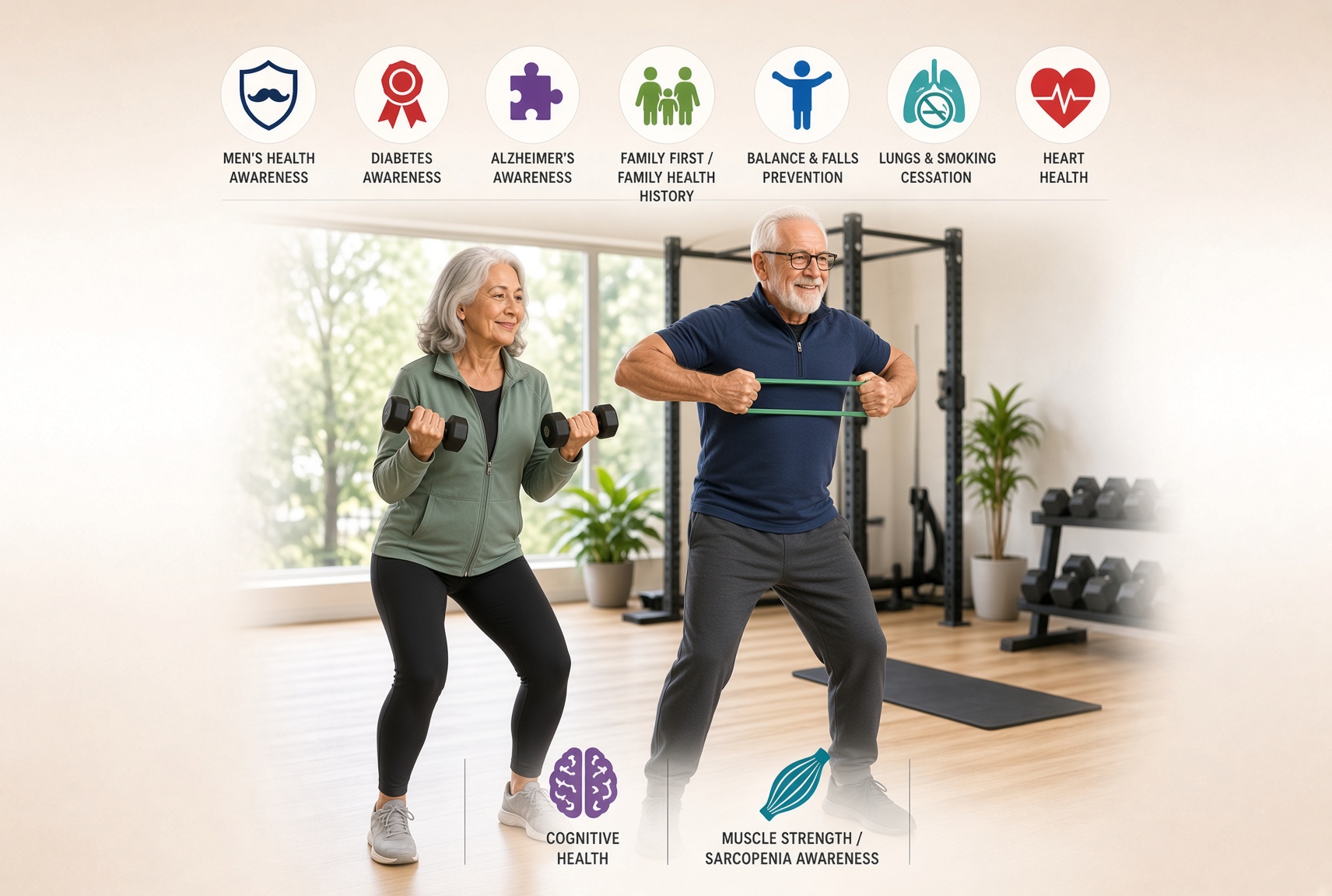
Today (1 November) is the start of several of the month-long themes that run through November: National Muscle Health Month, National Diabetes Month, Alzheimer’s Disease Awareness Month, COPD Awareness Month, Lung Cancer Awareness Month, and Movember. It is also World Vegan Day and the beginning of International Stress Awareness Week in some calendars. The common thread is still the same: muscle, movement, recovery and everyday habits that support a longer healthspan.
November has a few awareness themes that actually line up with something practical: keeping your muscle and your ability to move as you get older.
Weekend of 7–8 November – National Muscle Health Month
This is the main one. Muscle is not just about how you look. It is one of the main things that keeps your blood sugar in check, helps you stay steady on your feet, and makes everyday tasks possible without thinking about them. Most people start losing it steadily after about 40 if they do nothing. That loss (sarcopenia) makes stairs harder, raises the chance of falls, and is linked to worse metabolic health.Metabolic health simply means how well your body handles energy, blood sugar, blood pressure and fat storage. When it is not working well you often see things like:
- rising blood pressure
- higher blood sugar or type 2 diabetes
- increasing waist size or difficulty losing weight
- higher triglycerides and lower HDL (“good”) cholesterol
- feeling tired after meals or struggling with energy through the day
Stress sits next to it because if you are constantly run down or not recovering, it is harder to hold onto the muscle you already have.
A couple of years ago there was an 80-year-old lady who had never exercised or set foot in a gym before. She had an extremely painful (“bone on bone”) knee but had turned down surgery because her sister’s knee operation had gone wrong. So her daughter suggested she work with me. We did 30-minute sessions, just once a week, because that is all she was willing to do. I would start with a 5-minute leg and hip massage, finish with another short massage, and in the middle we worked on strengthening her legs and some simple balance exercises.
Within a few weeks she was crying with relief one day, telling me her knee was 95% better and how only I had been able to help her. She also confided to her daughter that, for the first time in 20 years, she could now sit down cross-legged again. She started going for a walk with a neighbour every day.This shows us that:
- Exercise and lifestyle changes still help, even if you are over 80.
- Muscle strength improves things you did not even realise were connected (her knee, her ability to sit cross-legged, her confidence to walk outside).
- Even a small amount of exercise can have a noticeable impact, especially when it is targeted and done with someone who understands how to build strength safely for that person.
- Pain and “I can’t” are not always fixed limits — sometimes they improve once the surrounding muscles get stronger and the joint is better supported.
- Consistency with a very small dose often beats occasional big efforts that never stick.
Weekend of 14–15 November – Diabetes Month + World Diabetes Day
Diabetes Month and World Diabetes Day (14 November) are a reminder that blood-sugar control is not only about food. Muscle is a major place the body stores and uses glucose. People who keep more of it generally handle blood sugar better. Strength work and regular movement are still among the most reliable things most of us can do for this, whether we are trying to prevent type 2 diabetes or manage it.
Weekend of 21–22 November – Alzheimer’s Awareness + Take a Hike Day + Lung and Men’s Health days
Alzheimer’s Awareness Month fits the same picture. Regular movement, including strength work, is linked with better cognitive outcomes later in life. It is not a cure, but it is one of the things that appears to matter.
National Take a Hike Day (17 November) is a simple reminder to get outside and walk. It does not need to be long. Consistent walking still helps strength, balance and mood.The lung-health days (COPD Day on the 18th and the Smokeout on the 19th) and International Men’s Day (also the 19th) can sit together. Quitting smoking is still one of the highest-leverage things someone can do for lung capacity and longevity. For men, the gap in life expectancy is still real, and strength and regular activity are practical ways to close some of it.
Weekend of 28–29 November – Movember + Family Health History Day + Fall Prevention
Movember runs all month and covers men’s physical and mental health. Strength training is a useful entry point for many men who are not already exercising regularly.
National Family Health History Day (26 November) is a prompt to notice patterns in the family — early heart disease, diabetes, dementia — and then decide what is actually within your control. You cannot change your genes, but you can change how much muscle you keep, how you move, the quality of your diet, how well you sleep, and the rest of your lifestyle.
Fall prevention comes back to the same point as Muscle Health Month. Strength and balance are what keep people independent. Once someone starts avoiding stairs or getting up from the floor because it feels risky, it gets harder to reverse. Strength work earlier (or even later) is one of the more direct ways to interrupt that.
None of this needs a complicated programme. Keeping and building muscle, moving regularly, managing recovery, and not smoking are among the higher-return things most people can do for their healthspan. The rest is largely detail.
If you would like help working out a simple plan that actually fits your current lifestyle, goals and time, and that includes some accountability so it sticks, get in touch. Even a small, consistent dose can make a real difference.
Emanuela
Holistic Personal Trainer, Pilates & Rehab Specialist
www.pilatesfitness.co.uk
References
- Zhao Y, Jiang Y, Guo Y, et al. Long-term impact of sarcopenia on functional decline and mortality in community-dwelling older adults: a systematic review and meta-analysis. Frontiers in Nutrition. 2025;12:1652386. https://www.frontiersin.org/journals/nutrition/articles/10.3389/fnut.2025.1652386/full
- Cruz-Jentoft AJ, et al. (Global Leadership Initiative in Sarcopenia). Health outcomes of sarcopenia: a consensus report by the outcome working group of the Global Leadership Initiative in Sarcopenia (GLIS). Aging Clinical and Experimental Research. 2025. https://link.springer.com/article/10.1007/s40520-025-02995-9 (PMC: https://pmc.ncbi.nlm.nih.gov/articles/PMC11929733/)
- Resistance training enhances metabolic and muscular health and reduces systemic inflammation in middle-aged and older adults with type 2 diabetes: a meta-analysis. Diabetes Research and Clinical Practice. 2025;229:112941. (Meta-analysis of 43 randomised controlled trials, n=2,012). https://www.sciencedirect.com/science/article/abs/pii/S0168822725009556 (PubMed: https://pubmed.ncbi.nlm.nih.gov/41106502/)
- Effect of physical activity on risk of Alzheimer’s disease: A systematic review and meta-analysis of twenty-nine prospective cohort studies. Ageing Research Reviews. 2023;92:102127. (Over 2 million participants). https://www.sciencedirect.com/science/article/pii/S1568163723002866
- Jha P, et al. Smoking Cessation and Short- and Longer-Term Mortality. NEJM Evidence. 2024;3(3):EVIDoa2300272. (Pooled analysis of ~1.5 million adults across US, UK, Canada and Norway, 15-year follow-up). https://evidence.nejm.org/doi/full/10.1056/EVIDoa2300272
- Le TTT, Mendez D, Warner KE. The Benefits of Quitting Smoking at Different Ages. American Journal of Preventive Medicine. 2024. https://www.ajpmonline.org/article/S0749-3797(24)00217-4/fulltext
- Exercise based reduction of falls in community-dwelling older adults: a network meta-analysis. European Review of Aging and Physical Activity. 2023;20:1. (66 RCTs). https://link.springer.com/article/10.1186/s11556-023-00311-w
- Follow-up efficacy of physical exercise interventions on fall incidence and fall risk in healthy older adults: a systematic review and meta-analysis. Sports Medicine – Open. 2018;4:56. https://link.springer.com/article/10.1186/s40798-018-0170-z